Showing posts with label Art and Activism. Show all posts

Thursday, May 15, 2025

FRICTION


LOST

I’ve been watching LOST lately. Actually, I watched it until the end of season 3 and with the increasingly strange turn of events, I’m literally feeling lost and finding the show unwatchable. So that’s where my journey with LOST will conclude.


One of the best episodes was in season 1 when Locke explains to Charlie about the moth struggling to get out of its cocoon. Locke explains that although tempting, humans need to refrain from helping that moth out by opening the cocoon on its behalf. He explains that the struggle to get out on its own is how the moth develops its survival skills. And if an unknowing human curtails the struggle, we likely curtail its ability to survive in nature, outside of its cocoon.

This episode makes me think about the concept of critical thinking. The way I define critical thinking for students that I teach is as follows:

Critical thinking is the ability to analyze information or opinion and articulate questions about the information with curiosity and consideration of other points of view. It is the ability to either push back against or underscore in agreement with the original information/opinion.


FRICTION

That last part about pushing back is important. It’s tempting as parents or teachers to try and smooth out all the wrinkles in life or a lesson plan so that there is no friction in the room. “Fun” and “happy” can be manufactured to no end. But friction isn’t bad and it isn’t not fun. It’s uncomfortable but it’s ok for students to feel friction or discomfort with an idea and allow them the space to state their case in response to that friction. And it’s really the only way they learn to analyze, articulate, push back or underscore. It’s the only way they learn how to exit that cocoon on their own and make it in the world.


ENVIABLE GEMS 

Right now, I am struggling with the friction of how to push back against a national narrative that seeks to destroy higher education. Not all voices within higher education align with mine but the revenge-based methods of crippling institutions that have been the brightest jewels of our nation has me shook. Couple that with cruelty-based methods to cripple the arts and public libraries—spaces that have given me and my family oxygen and identity and purpose tempts me to participate in what has become sport in our world, which is to come up with the next most grotesque chainsaw to hurl. 


I don’t want to hurl. 


And I don’t want to avoid the struggle or the fight. As Sahil Bloom writes, “The growth you asked for is hidden in the struggle you avoid.”


I want to channel my rage and find my way out of the cocoon and I want to meet others who are striving to do the same as we collectively push back to protect, and yes to thoughtfully reform one of the few enviable gems of American culture. Gems that make groundbreaking discoveries through research, and gems that with academic freedom teach in ways that ignite critical thinking.


Tuesday, February 11, 2025

So Speak with Nuance


NIKE & LAMAR
Did you see that Nike commercial during the Super Bowl? I loved it. The message gave me new inspiration to consider that the best part of being a free human is the ability to think and speak freely. The psychology of human development posits that in order to express our authentic selves, we first need to feel secure. Financially, emotionally, physically and all the other adverbs. In other words, we need to know that it's safe before we take risks with our words and actions. 

The one thing I loved more than the Nike commercial was the last moment of Kendrick Lamar's performance where he was daring us to turn him off before he pulled the plug and turned us off. Such poetic nuance.

Whether I am working with college, high school, or middle school students, it seems that no one is immune from the pressures cast by our attention-driven economy to forego heart-to-heart conversations about difficult topics and instead go straight to social media to broadcast the next best insult that can potentially go viral and slash the jugular of our perceived enemy. Fuck nuance. We've got a brand to not authentically but performatively build.

TERF & WOKE
One such difficult conversation in this modern day is about gender identity. It seems almost impossible to agree with the likes of Martina Navratilova who has spoken about the need to prevent transgender women from competing in women's sports without being characterized as being a hateful TERF. It also seems impossible to say that transgender women deserve to live their best lives free from bullying, without being characterized as a WOKE Libtard. Because fuck nuance.

JANUARY 6th
Another difficult conversation is about the events of January 6th. It seems impossible to on the one hand say we need to support the police whose job it is to preserve law and order without being characterized as a right wing racist. It is also risky to say that Daniel Rodriguez, Thomas Sibick and countless others who attacked Michael Fanone and other DC police on January 6th should not have received a presidential pardon without being characterized as part of the deep state. Because fuck nuance.

REDEFINING ACTIVISM
It's tempting to define activism as loud, insulting and lacking nuance. It's tempting to chase the exhilarating viral shouts and forego the smaller connections and deep conversations laced with disagreements. In many ways, our world is saying you can't unplug, and you can't speak with nuance. 

And I say,

So speak with nuance.


Saturday, December 2, 2023

DEAR AMJAD, YOSSI and EZRA


DEAR AMJAD IRAQUI, YOSSI KLEIN HALEV, & EZRA KLEIN:
I am writing this letter to you after having listened to two episodes of the Ezra Klein podcast as follows:
  • The November 7th episode where Ezra interviews Amjad, and
  • The November 10th episode where Ezra interviews Yossi.
Thank you all for availing yourselves to these conversations which in turn allows me to confront and grapple with the difficult and conflicting narratives surrounding the current state of the Middle East.

OCTOBER 7th
October 7th is fresh on my mind because it seems like it happened just yesterday. My body responded to that day with my jaw dropping, my eyes weeping, and my heart aching for the people murdered and tortured by Hamas. Today, it's almost two months past October 7th. And before we know it, we will see October 7th shapeshift as it drifts farther away from us. As i see the brutal retaliation by Israel with countless deaths of innocent Palestinians, my jaw drops, my eyes weep, and my heart aches. My soul shakes into a single-word prayer on repeat. That single word is: Please. In Spanish it's por favor. In Korean, it's 제발.

To try to understand WHY October 7th happened, I know I need to understand a story that doesn't begin on that date. It begins more than 75 years ago, maybe longer than that, back to 1917 when Palestine was under British rule, and the British announced a "national home for the Jewish people" to be developed within historic Palestine (Balfour Declaration, November 9, 1917).

A student of mine who is of Arab descent joined me in taking on the challenge of also listening to your interviews, examining your conflicting narratives, and writing among many things in her paper that "both Palestine and people of Jewish descent share indigenous roots to this region and there needs to be a mutual agreement on this from both parties."

Let's assume that everyone can agree to that. Even with such an agreement there have been bad behaviors that get in the way of long-term hope for peace because no one seems to be able to move past the bad behaviors and the insatiable thirst to exact the next best revenge.

BAD BEHAVIORS
Bad behavior #1 of many: Israelis have been militarily occupying Palestinian territory. Extremist religious settlers have invaded much of this territory, inch by inch, in a way that threatens the very existence of the Palestinian people and subjugates their daily existence in oppressive and humiliating ways. Yossi: Even you point out that you (along with many Israelis) who have opposed Netanyahu and his regime's oppressive treatment of Palestinians were marching in protest against Netanyahu all the way up to October 6th, with the threat of an Israeli civil war in regards to this injustice, moving increasingly toward the realm of possibility. And how after October 7th, all of that changed, as the trauma inflicted by Hamas has banded Israelis together to respond not to what was immediately in front of them pre-October 7th but what they see immediately in front of them post-October 7th: fear and terror.

Bad behavior #2 of many: With the departure of Israelis from Gaza in 2005, Palestinians voted in Hamas to lead Gaza. Yossi: you describe Hamas as the materialization of an idea—that Israel needs to be destroyed—a materialization that views armed terrorism as a tactic that you, Amjad, characterize as being the only viable tactic that Hamas believes in, because Hamas believes other tactics as having been ineffective. When I listen to your explanation of this, I have to remind myself that what may sound logical on paper is illogical in real life. I reject the notion that armed terrorism is a tactic equally weighted and therefore interchangeable with other tactics.

PEACE & LIBERATION
My student who has seen in the media, the relentless bombing of Gaza, argues that Israel is now acting beyond the scope of self-defense and says, "This is not self-defense, it is execution for Palestinians." She further points out the irony of an Israel set on destroying Hamas since as Yossi points out, Hamas is not just a militia, but an idea. And ideas cannot be destroyed. Especially through bombs. My student concludes her piece fueled by righteous anger that "Peace isn't the answer; liberation is."

I understand her rage. Though I have never lived under occupation, my parents have. From 1910 to 1945, Japanese colonizers occupied the people of Korea, including my mom and dad. And on August 14, 1945, Korea became divided into a North and a South, split along the 38th parallel, marking the surrender of Japan and ushering in the end of WWII. This division was intended to be temporary. Some 78 years later, "temporary" can be used to describe the division ironically, certainly not realistically. It is a division that makes we Koreans fear half of ourselves and distrust and begrudge neighbors who look more like us, eat more like us, and have cultural mannerisms more like us than most of the world. And despite the sameness, they for 35 years colonized us. Occupied us. Humiliated us on the daily.

OCCUPIERS & OCCUPIED
As author Kathy Park Hong points out in her book Minor Feelings, Koreans are a people who have always been on the run as we:
... first went to Manchuria to escape the Japanese occupation, then to Seoul to escape the Soviet invasion, then to Busan to flee North Koreans, and finally to the United States to escape the South Korean dictatorship. And in this 21st century, we know that life in North Korea remains a nightmare, causing people who choose the potential terror that will be theirs if caught defecting, to try anyway.

How can neighbors with an ancestry so similar have constructed relations where one became occupier and the other occupied? This is a question that can be asked not only of the Japanese and Koreans but also the Israelis and Palestinians. How can neighbors who hold legitimate indigenous roots to a region and even share a Semitic identity (i.e., Semites are people who speak Semitic languages especially Hebrew and Arabic) be at once occupiers and the occupied?

I think there is a growing societal sentiment that in order to pursue justice, we need to become agnostic toward the idea of compassion. More and more, I see jaws not dropping and hearts not sinking unless there is assurance that it's safe to do so; that is, as long as the suffering can be framed to keep a pure tribal fidelity of narratives that say who is qualified to be viewed as victims and who is not. It is a rigid binary that I am sure exhausts even the most fervent tribal leaders.

GEORGE FLOYD
When the George Floyd murder happened a few years ago, the pain in the community had people saying assorted things. One thing that some people said was "defund the police." Other people said other things that weren't as sensational, which was essentially, to improve the police. And to improve human connection. To get people talking and interacting and connecting and caring to combat loneliness and to foster belonging. To get bad cops out of the force and to get leadership to negotiate and collaborate and create new and better ways of policing. 

THAT IS MY UNCLE
Before George Floyd was Rodney King. During the civil unrest that exploded in response to King's unwarranted beating by police in 1992, a weird tension developed between African Americans and Korean Americans in Los Angeles. Korean businesses were being looted and vandalized, with a narrative that justified this action, pointing to Koreans' stoic and unfriendly demeanors, along with their businesses profiting from African American patrons. There were ridiculous and hurtful sentences hurled from both communities.

Why do I bring this up? Because in that moment, I felt there was a hopelessness kicking in with people starting to believe that peace was less important than liberation. I felt a desperation when my uncle decided to arm himself to protect his business in Los Angeles as he and his community were being targeted as the oppressive enemy. On the one hand, I wanted to shout to my uncle: "Stop! We are in the same boat as them!" And on the other hand, I wanted to shout to the African American community: "Stop! That is my uncle! That is not Laurence Powell! That is not Daryl Gates!"

And the entire experience had me ask: How can freedom have value when the context is violence and terror?

I thank you for giving these interviews so that I can have the opportunity to strengthen my thinking. As President Obama recently stated, there is no way to speak the whole truth at once. We can speak a slice of truth. And if we dare to be truly brave, we can listen to, and grapple with other slices. I realize that to speak even one small slice, a lot of time and energy is required. I thank my student and also my trusted colleagues for joining me in investing this kind of time and energy at this moment. Perhaps they will join me and perhaps you will also join me in my current single-word prayer to God who I think can be accessed through many paths:

Dear God: 
Please. Por favor. 제발.
 

Hear my prayer. 

Amen.

Sincerely,

Jenny 

//

Amjad Iraqui is editor at +972 magazine and policy analyst at the Al-Shabeka think tank. Here is the link to his interview with Ezra Klein.

Yossi Klein Halevi is a senior fellow at the Shalom Hartman Institute in Jerusalem. Here is the link to his interview with Ezra Klein.


Wednesday, November 3, 2021

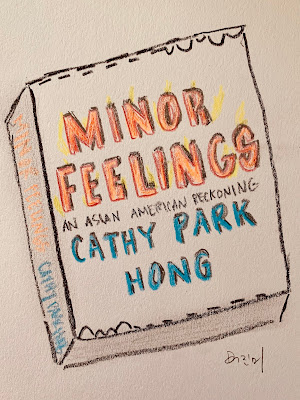
MINOR FEELINGS by Cathy Park Hong


There is a passage in Minor Feelings by Cathy Park Hong where she explains to her friend Erin that "it's a problem how Asians are so private about their own traumas, you know, which is why no one ever thinks we suffer any injustices. They think we're just these robots."

The passage reminds me of one of my deepest traumas that occurred during my senior year in high school in Bakersfield. It was toward the end of the school year and I was sitting in my usual seat in the very back of Chemistry class with our teacher Mr. En trying to keep our restlessness on a low simmer as we were waiting for class to end, the year to end, and something new to begin. During one such afternoon, Bouncy Cheerleader Em was playfully teasing Mr. En asking him "Mr. En, will you remember us after we are gone?" 

To which Mr. En said "Bouncy Em, there are some people who will be remembered, like you. And then there are some people who will never be remembered and always forgotten, like ... like ..."

As Mr. En was surveying the classroom to select the student that he would name as an example of the forgettable, my stomach sank as I prayed silently and fervently: "Please God, please don't let him say my name. Please God, please make the minute hand go to seven so it can become 3:07 so the bell can ring and I can leave. Please."

"Like ... like ... Jenny Doh. People like Jenny Doh will be forgotten."

From the time that Mr. En uttered those words until it became 3:07, everything seemed to go in slow motion. My affect flattened but everyone else seemed to be just fine. Nothing about that moment horrified anyone else but me. I wanted to die and I wanted to appear perfectly fine all at the same time. I kept that trauma private and allowed people to think that my robotic self hadn't been hurt. 

Like most Korean Americans, I was raised with a belief that it is a virtue to quietly endure. In Korean culture, the word is 차마 (pronounced chamah). Where no matter how deep it hurts, we endure it. In a scene where her artist friend Helen experiences deep trauma, Park Hong wonders whether Helen is going to kill herself and then remembers that stronger than Helen's "will to die was her will to endure" and that "This was the most Korean trait about her, her intense desire to die and survive at the same time."

Other related Korean virtues include 고생 (pronounced gohseng) which means to suffer, and the ability to repay 신세 (pronounced shinseh) which means indebtedness. It is no wonder that to endure, to suffer, and to repay debt are the virtuous cornerstones of the Korean people. Historically, we are a people who have been occupied, divided, and underestimated. And quietly, we have endured, suffered, and worked diligently to repay real and perceived indebtedness.

Park Hong describes the dynamic of how language of the dominant and the language of the dominated develop differently by saying that "English tuned an experience that should be in the minor key to a major key; there was an intimacy and melancholy in Korean that were lost when I wrote in English." For me, it's not just in the written word, but in the spoken word, where in English, I find more know-it-alls who for whatever reason wake up every morning and decide that it is their job to shout out answers to questions that no one has asked of them. Because they know it all. All the time and always in the hyper major key. 

But put them in a room with a Mr. En who publicly characterizes a quiet Korean American girl as forgettable and they won't say boo, because as Park Hong cites Robin Bernstein's book Racial Innocence, "Innocence is not just an 'absence of knowledge' but 'an active state of repelling knowledge,' embroiled in the statement 'Well, I don't see race," where I eclipses the seeing." 

Says Park Hong, "I sometimes avoid reading a news story when the victim is Asian because I don't want to pay attention to the fact that no one else is paying attention. I don't want to care that no one else cares because I don't want to be left stranded in my rage."

Maybe that's why we Koreans are frequently silent. Because in many ways, forgetting Mr. En through silence is easier than remembering him and all the inattentive witnesses through rage. But says Park Hong, "The problem with silence is that it can't speak up and say why it's silent. And so silence collects, becomes amplified, takes on a life outside our intentions, in that silence can get misread as indifference, or avoidance, or even shame, and eventually this silence passes over into forgetting."

Wednesday, March 17, 2021

The Reading Lab: Free Speech & Activism


When we think of the concept of freedom, do we value only the freedom TO?
To speak.
To think.
To act.

Or do we also value the freedom FROM?
Freedom from harassment.
Freedom from intimidation.
Freedom from violence. (The kind that the Asian American community has been experiencing a lot of lately and other moments in history.)

When we think of freedom, is it something that belongs to an individual or also to a community?

When we start to notice harassment and demand that it stop are we cancelling the harasser or is the harasser feigning censorship because they’ve not been kept accountable before?

We will pursue these questions and more in my new online class in collaboration with Professor Lonce Bailey, titled The Reading Lab: Free Speech & Activism. Class begins April 9th. Details and enrollment info can be found here.


Everyone welcome.


Monday, March 1, 2021

THE WARMTH OF OTHER SUNS by Isabel Wilkerson


Approximately from 1915 to 1970, the servant class of America took action to leave the southern states of the United States as they embarked on a journey that would land them in northern and western states. About six million Black Americans took this action not by first asking for permission or announcing that they would. This historical truth of The Great Migration comes to life as Isabel Wilkerson, author of THE WARMTH OF OTHER SUNS, focuses on the stories of three specific black Americans who took this action:

  • Ida Mae Brandon Gladney took action to leave Mississippi and settle in Chicago
  • George Swanson Starling took action to leave Florida and settle in New York
  • Robert Joseph Pershing Foster took action to leave Louisiana and settle in Los Angeles. 
The research that Wilkerson conducts in order to present the pushes and the pulls associated with why blacks left the south is epic.

The big push to leave had everything to do with the indignity of living under Jim Crow laws that protected the practices of white people -- from segregation to abusive work environments, to lynchings. Pershing  Foster knew firsthand, about the indignity of living under Jim Crow. A man who would eventually become a medical doctor with a thriving practice in Los Angeles knew before the migration while growing up in Louisiana how he had to swallow his rage in order to survive Jim Crow. The need to do bide his time, and to do whatever it took to survive the oppressive eye of his white bosses ... in the streets, in the fields, in his dreams:

"Sometimes" he said, "you have to stoop to conquer" (page 117).

The big pull of the migration contained the stories of more enlightened northern and western states, where Jim Crow was reputed to be less overt and dignity for blacks reputed to be more attainable. Wilkerson presents fascinating research that documents migrants as having an unparalleled will to survive. Though they didn't cross bodies of water or actual borders separating nations, the hardships they endured by making this move caused them to do whatever it took to survive -- including working longer hours, taking multiple jobs, and taking jobs that others didn't want.

As an immigrant myself, I get that to my bones. 
And I get the value of:
  • delaying gratification
  • swallowing the rage, and yes, 
  • stooping to conquer.

Thursday, November 12, 2020

Expressions & Regulations


Emily Bazelon reminds us in her piece (Free Speech Will Save Our Democracy, NYT Magazine, October 13, 2020) that President Obama encourages us to allow all speech to occur, no matter how offensive, as we strengthen our speech so that the best ideas emerge as the most credible. Bazelon also reminds us of historically foundational thinkers upon which Obama's assertion rests, including Justice Oliver Wendell Holmes who in 1919 said "The ultimate good desired is better reached by free trade in ideas" and John Stuart Mill who wrote in (On Liberty, 1859) that it is wrong to censor ideas, because knowledge arises from the "clearer perception and livelier impression of truth, produced by its collision with error."

In Chapter 2 of The Free Speech Century by Lee Bollinger and Geoffrey Stone (2018), we find an essay titled Every Possible Use of Language? by Frederick Schauer. In it, Schauer cites Holmes as having given us the enduring idea that speech can be restricted on alleged dangerousness only if the danger is "clear and present." Most of us have understood this point by understanding the example he used to make this point, which is that no one is free to shout "Fire!" in a crowded theater.

What makes these traditional tenants of free speech challenging today is 1) the grotesque advances of technology that cause false information to spread like wildfire and 2) modern leaders like Donald Trump whose penchant for totalitarianism cause him to spread outlandish propaganda one day and on another day (when confronted by irrefutable proof of his earlier falsehoods) takes oblique and cynical cover by saying "I was just joking." 

Schauer argues that the First Amendment "cannot have been ... intended to give immunity for every possible use of language." In other words, some language is beyond the grasp of the First Amendment's protections. For example, when Trump's language inspired domestic terrorists earlier this year to devise a plan to kidnap and murder Governor Gretchen Whitmer, it would be hard for the First Amendment to kick in and regulate that speech because in the moment of Trump's language, dangers are likely speculative and likely distant. Not clear enough. Not present enough.

The good faith argument that all speech ought to be allowed in order for the best idea to win (a la Mill, Holmes, and Obama) may need further examination as we confront a modern context where our social media channels fuel the growth of totalitarian leadership-based dangers. Dangers that might not explode in the now but dangers that are dangerously flammable and uncomfortably adjacent to this moment.

Monday, August 31, 2020

THE FUTURE IS.


I support equality for women. It's in college when I opened my eyes to how deep-rooted and structural sex-based oppression is. It is when I became a radical, structural feminist.

However.

I'm not comfortable wearing a t-shirt that says "feminist." Or other variations like "the sisterhood" or "love your tribe" or "the force is female" or "the future is female." No thanks.

I'm uncomfortable with the notion that there is some sort of genuine sisterhood among ALL individual women. Some of the most egregious acts of cruelty I've experienced have been by individual women. Many women DON'T help women. Women shame. Women gossip. Women sabotage. Women envy. Women take down. So do men. Not all, but many. That's because women and men are human. And many humans (not all) don't help humans (including myself at times). 

I'm also uncomfortable with "the sisterhood" because as Roxane Gay points out in her book BAD FEMINIST, race remains a big problem within some feminist circles.

Because there are those very special individual women who go out of their way to support misogyny, white supremacy, nationalism and ickiness in general to pursue relevance and celebrity ... like Kellyanne, Sarah, Dana, Ann, Tomi ... and quite frankly the 53% of educated white women who helped put disgraceful Trump in office. And in the deep reaches of my radical feminist heart, I say that there are individual men who are more my sisters than these individual women.

When I (mainly through art) criticize/satirize individual women like Kellyanne, there are some voices who tell me that if I am a TRUE feminist, I shouldn't criticize any individual woman including Kellyanne. And further, that I should (hashtag) believe-all-women. 

To which I say: bull fucking shit.

If I believed all women, I would have believed Carolyn Bryant, whose testimony in 1955 led to the lynching of Emmett Till and who 50 years later recanted her testimony.

I support equality for women. Therefore, I support structures that compensate Kellyanne with the same pay that say a Sean Spicer is compensated. That I support structures to not favor Sean over Kellyanne for the same work does not mean that I condone what Kellyanne says or does. Nor that she has immunity from criticism/satirization because she is biologically female. 

The future isn't female.

The future is.
###

[This essay is a slightly expanded version from an earlier draft published on Instagram in August 22, 2016.]

Wednesday, August 12, 2020

Build Back Better


Yesterday, upon learning that Joe Biden selected Kamala Harris to be his running mate, Donald Trump stated that Harris is a "nasty woman" and that he couldn't understand how Biden could select her after she had "attacked" him on the debate stage during the democratic primaries.

What Trump was referring to was the moment during a debate when Harris called Biden out for having opposed a busing program some decades ago. A program that had been erected as a means of desegregating public American schools. Harris described a little girl who benefited from the busing program during that era and revealed that "that little girl was me."

It was a powerful moment.

The fact that Biden could move from that moment to self-reflect, learn, grow, hold no grudges, and ask Harris to be his running mate tells me a lot. It tells me that he doesn't need his rooms to be filled with yes-people. It tells me that he knows how to compromise, reconcile, and unite.

The fact that Harris could move from that moment to also learn, grown, hold no grudges and accept Biden's invitation tells me that she's able to say important things besides "yes" to Biden and to also compromise, reconcile, and move forward.

The fact that this type of collaboration befuddles Trump tells me that Trump needs all people in a room to say nothing but yes to him. And if there is anyone who veers off of being a yes-person or even looks at him the wrong way, it's not only off with their heads, but it's off with their heads with maximum humiliation. That's not American. That's authoritarian.

I'm proud to be supporting the Biden/Harris 2020 ticket because they are ready to listen, to be challenged by non-yes people, and to restore the soul of our nation. At a time when we are all asking why we are so polarized, I say let's ready our listening ears and steady our voices and join Joe Biden and Kamala Harris as together, we Build Back Better. 

(Art: Gouache and collage on paper.)

Sunday, August 2, 2020

CONSTANT GARDENERS


ROSE & THORN
Last week during our zoom discussion for the Summer 2020 online Art & Activism class (Unit 4), we did an "around the table" closing exercise where we talked about what each of our roses of the moment and thorns of the moment are. Some of the responses got us roaring with laughter, while others got us a bit contemplative and teary. 

My contributions were as follows: 
GARDENS
One of the through lines for many of the responses had something to do with people's gardens. From the challenges of keeping pests away, to the glories of harvesting cucumbers and making them into homemade pickles, I realized that keeping a garden requires constant upkeep.

For the last year, Gerardo has started dabbling with a vegetable garden that he grows in small pots. He is growing zucchini, tomatoes, and a few herbs. Every morning I see him go outside to tend to his garden and when he enters the house, he has stories to tell about caterpillars, wasps, worms, the sun, the dirt, water, and weeds. 

PROTESTS
Recently, I made a painting to honor the Wall of Moms who have been out in Portland protecting its protesters. The person who bought the painting is an actual mom from Portland. During our interaction regarding the sale, I learned that she has been protesting for decades since her first protest against the Vietnam War in the 1970s.

Her biography made me think about some of the signs I've seen during protests that I've marched in. The ones held by older humans who have been marching for years as they hold up signs that say something like: "I can't believe I have to explain this shit AGAIN." 

EMPTY GARDEN
All of this made me think about the song Empty Garden by Elton John  (a tribute to John Lennon) which starts off like this:
What happened here
As the New York sunset disappeared
I found an empty garden among the flagstones there

Who lived here
He must have been a gardener that cared a lot
Who weeded out the tears and grew a good crop

And now it all looks strange
It's funny how one insect can damage so much grain

To be an activist is to be a gardener. It's about pulling weeds, controlling pests, and optimizing a social context so that greed and oppression and authoritarianism do not take over. Activism, like gardening, is constant. It's challenging. It's rewarding. It's never-ending. And if we are lucky, when the world looks upon our lifelong dedication to activism, it will recognize that we must have been gardeners that cared a lot. That we weeded out the tears. And we grew a good crop. 

(Art: Gouache and typing on paper)


Saturday, July 11, 2020

THE INVISIBLE, FOUNDATIONAL MUDSILL

MUDSILL
I just learned that the wood beam that gets secured along the foundation of a house is called a mudsill. Onto this mudsill is where additional beams get attached, allowing the entire framework and eventually the entire house to be constructed. Isabel Wilkerson provides this information in her essay (America's Enduring Caste System, NYTimes Magazine, July 1, 2020) to help us understand structural/systemic racism.

CASTE IS
She reviews the traditions of India and its caste system and points out that it is one where people are born and ushered into a hierarchy where their destinies are predetermined by social status and perceived inherited purity. Why the caste system has endured is largely due to the religious/cultural belief that the only way to eventually move up via reincarnation is to adhere to the place in the caste that a person finds herself currently in. In order to one day do jobs other than clean and serve, a person on the lower level of a caste is taught that only by not resisting her lot in life will she eventually move up the system in a future life to perhaps do things other than clean and serve.

Says Wilkerson: "Race, in the United States, is the visible agent of the unseen force of caste. Caste is the bones, race the skin." And because bones live under the skin, the structure of oppression isn't necessarily visible. Rather, it's understood, assumed, and breathed. Caste is.

THE BUSINESSMAN
Wilkerson shares a story about how years ago, she was on assignment as a reporter for The New York Times to do a Chicago-based story. She arrived early to interview a successful Chicago businessman that she had planned to feature in the story. Once the businessman arrived, he refused to believe that Wilkerson, a black woman, was the reporter. No matter how much she explained that she was, he refused. So Wilkerson left without an interview.

RUNGS & ROOTS
To live in the United States caste system means that black people are viewed to exist at the lowest rung and white people at the highest. Asians, Latinos, and other people who aren't black and who aren't white straddle in-between rungs with unease, "as they aspire to a higher rung."

Wilkerson explains that she never named or shamed the businessman from Chicago "because of our cultural tendency to believe that if we just identify the presumed-to-be offending outlier, we will have rooted out the problem. The problem could have happened anyplace, because the problem is, in fact at the root."

In other words, the caste is built into the structure, the mudsill. And like roots, the mudsill isn't visible. It is foundational.


Sunday, June 21, 2020

BOYS IN THE BOAT by Daniel James Brown

OARS IN WATER
In college, my favorite professor said to me that if I cared about an issue, I needed to keep my oar in the water. He asked me, are you gonna fight to direct the boat or are you going to let others determine its course? And if not in college, when are you going to practice your strokes? Because it won't get any easier once college is over. In other words, he was asking whether I was going to stay in the discourse during class discussions (especially when it got heated) and use my voice, or give up. Yes, the difficulty.Yes, the exhaustion.

GOLD
THE BOYS IN THE BOAT by Daniel James Brown is a book about the crew of eight from the University of Washington that went to the 1936 Olympics in Berlin. And against all odds, this crew out-rowed the German crew, the Italian crew, and every other crew to bring home the gold, and in the process discombobulating Hitler's confidence in his boats.

In telling this story, Brown shares the unique qualities that make up this sport. It's not just about a high number of strokes per minute, but also about how strong and steady each stroke can be.

It's not a sport for individuals to show off individuals strengths. Rather, it's a sport where individuals become one unit by making modifications as needed ... where a rower with a shorter reach learns to reach longer, and a rower with a longer reach learns to foreshorten his/her reach so that every rower can be in synch with one another, causing the boat to attain a rowing nirvana referred to as "swing."

Synchronicity through modifications of individuals doesn't mean every rower is exactly the same. Actually, the diversity of each rower is valued:
Good crews are good blends of personalities: someone to lead the charge, someone to hold something in reserve; someone to pick a fight, someone to make peace; someone to think things through, someone to charge ahead without thinking (page 179).
When one of the boys in the boat named Joe was having difficulty finding synch with the other boys, he was advised by a mentor who said to him:
If you don't like some fellow in the boat, Joe, you have to learn to like him. It has to matter to you whether he wins the race, not just whether you do (page 235).
BLACK LIVES MATTER
I can't help but extrapolate how these truths about rowing apply to life, especially at this moment where our nation is waking up to what it means when we say "black lives matter." A concept so clear that some people uncomfortable with the power of its clarity manufacture absurd complexities about it on purpose.

Through the video footage of George Floyd's murder, privileged Americans are witnessing visual evidence of what has been conceptually discussed about for years. And the video is finally causing a broad coalition to realize that in order for our crew to succeed, it has to be about more than individualism. It has to be about WE.

REGARDLESS
And if my professor from years ago were still alive, he would be saying to we the coalition to keep our oars in the water. Regardless of the difficulty. Regardless of the exhaustion. Because at what other time than now will we have the chance to row such significant waters?

Wednesday, June 3, 2020

MOBILIZATION v ORGANIZATION

MOBILIZATION
I've been reading a book titled No Shortcuts: Organizing for Power in the New Gilded Age by Jane McAlevey. McAlevey is an extraordinary union organizer who has lots to teach about how to bring about change.

The most mind-blowing takeaway for me has been that mobilization is not organization.

Examples of mobilization include: marches, rallies, putting a black square on our social media handles, and protests at airports (to name a few). People can be mobilized rather quickly because people only need to read a headline to get fired up and then to show up. Sometimes, they don't even need to read a headline. I remember when I was a graduate student at UCLA and there was an issue that some of us were thinking about protesting. And one of my colleagues said "Do we want a bunch of people to come and get naked? I know a bunch of people who will do that if I just give them a call."

We saw mobilization happen when Trump issued Executive Order 13769 in early 2017, also known as The Muslim Travel Ban. Thousands of people mobilized in airports to protest this ban. It happened fast and it took my breath away to witness what I view as our nation's salt of the earth decide quickly to come out and stand up for justice. Prior to the airport protests was the Women's March when the entire world mobilized to march and protest the sinful administration.

ORGANIZATION
What makes organization different from mobilization is that it takes a very long time. It takes lots of conversations not only about how nice or mean an individual is, but how functional or dysfunctional systems are.

This morning on The Daily NYTimes podcast with Michael Barbara, I was blown away by the reporting by Shalia Dewan who presented eye-opening information about why it is almost impossible to create positive reform within law enforcement.

When there is a complaint about a cop, the internal affairs division kicks in to investigate. In other words, the police are being left to police themselves. When there is a complaint that is investigated, police use the argument of precedent to protect a bad cop. In other words, if there is a precedent of leniency for a misbehaving cop, that precedent is used to argue for the same leniency for the bad behavior of the moment.

President Obama released his statement about our current crisis a couple of days ago. In it, he said:
"If we want to b ring about real change, then the choice isn't between protest and politics. We have to do both. We have to mobilize to raise awareness, and we have to organize and cast our ballots to make sure that we elect candidates who will act on reform."
This afternoon, President Obama provided comments via television to underscore the importance of both mobilization (which is what we are seeing all around us) and the difficult and arduous work of organization. I think the organization part has many prongs. It's organizing to vote and get good people into office. It's also thinking locally and talking with neighbors about a matter like police reform, use the points that journalists like Dewan unearth, and then latching onto our city leaders and not letting them off the hook for a very long time until reforms are made.

LISTENERS
McAlevey notes that the way to find the true organizers in a movement is to find the ones who are listening, not performing. Organizing leaders listen more than they speak, they read and think and converse in order to understand the complexities of an issue, and they dig into the work with a tenacity that lasts not a day or a week or a month ... but years. A lifetime, actually.

Tuesday, June 2, 2020

WHERE'S ANDREA? #blacklivesmatter

When I was a new immigrant to this country, I was the only girl of Korean descent in the elementary school that I attended in Bakersfield, California. Amy B. Seibert School. There was a bully named Andrea who used to slap my face regularly.I told my family about this and Marilyn, from our sponsoring American family, started coaching me with my limited English skills and told me the next time it happened, I should look at Andrea in the face and say "Stop it!" And so I did. But it didn't work.

So the next thing I knew, Marilyn accompanied me to school and asked me "Where's Andrea?" I pointed her out and witnessed Marilyn going over to talk to Andrea and telling her in no uncertain terms that she was to stop slapping me. 

It worked. Part of the reason it worked is because Marilyn was a pillar in the community. A woman of stature. Her husband was also a pillar. They, along with their three children are the Americans who helped us find our footing, doused us with love, and cheered for our success. The Wulfekuehler family. 

Andrea heard Marilyn loud and clear. Even though I was different, I mattered. If someone had said to Marilyn "But what about Andrea? Doesn't she matter too?" Marilyn probably would have said "Of course she matters. But I'm here not because someone is slapping Andrea. I'm here because Jenny is being slapped. And I'm not going to not do or say anything about that." I think that when a nation has a long-standing track record of killing unarmed Black people, it is not illogical for someone witnessing that to speak up. And when the witness stands to speak, they may say something like "Stop it!" Or a collective community of witnesses may say it another way, like #BlackLivesMatter

To me, those three words don't mean that other lives don't matter. Because of course Jenny matters and Andrea matters too. This great nation protects the right for Marilyn to speak up and get involved and it protects a collective group of like-minded and concerned witnesses to stand together ... to state the case and shine light on matters of importance. 

(I am reposting today, this story of mine which I originally posted on July 12, 2016. Today, as our nation is hurting, and as some people STILL don't understand that saying a person's life matters isn't saying that another person's life doesn't matter, I hope this story helps create some understanding. One day much after that fateful day in 1974, I overheard my mom asking Marilyn how we could ever repay her. And you know what Marilyn said back to my mom? She told her to pay her back by passing along the kind of love and support that the Dohs received from the Wulfekuehlers onto another person or persons in need, whoever or wherever or whenever that may be.)

Monday, June 1, 2020

I DON'T KNOW

YESTERDAY
Yesterday, my daughter Monica and I joined our Santa Ana friends to participate in a multi-mile march to support Black Lives Matter and to support the seeking of justice for George Floyd, Ahmaud Arbery, Breanna Taylor, and countless other Black Americans lost to systemic racism. Andrea (one of Monica's closest friends from childhood) impressed me with her strong and fearless activism as she held a bullhorn and led a lot of the chants for all of us.

At one point during the march, Andrea shouted "What do we want?"
And we shouted back "Justice!"
"When do we want it?" Andrea continued.
"Now," we yelled.

And then she shouted something that I'd never heard at a march: "How do we get it?"

And as soon as that question came out of Andrea's bullhorn, we all started looking at each other as many of us started saying to one another "I don't know." I also said it to people around me: "I don't know."

TODAY
Today I woke up with blisters on my feet and opened the link that contained President Obama's remarks about our current situation. His words served as a balm for me and many others I'm sure, as we remain parched to hear words from our leaders that can start healing and motivating us. One of the things he said was as follows:

"If we want to bring about real change, then the choice isn't between protest and politics. We have to do both. We have to mobilize to raise awareness, and we have to organize and cast our ballots to make sure that we elect candidates who will act on reform."

THE OTHER DAY
The other day I listened to a great episode of Esther Perel's podcast where she was providing marriage counseling for an American couple living in Nigeria during this pandemic. As the couple shared their relationship challenges, one big takeaway that Esther helped facilitate is that sometimes, when one spouse is hurting, the other spouse might feel the need to "solve" the hurt.

But the thing is that sometimes there isn't a clear cut solution and sometimes, the solution comes from a place different than the spouse. Or sometimes, there may be a road toward a solution but rather than playing savior to the problem, the most helpful thing that a spouse can say is as follows:
"I'm sorry. This sucks." 
ALSO TODAY
One of my good friends Shamanie checked in with me to see how my family is doing. She knows that my husband has had some major health issues, including a recent emergency scare where he spent some time in an Intensive Care Unit. Shamanie asked me "Can I order food to be delivered for your dinner to give you a break?" And I said "Thanks but I'll save that offer for a future rainy day." And she said "I'm here for you." And I said, "I know. Just knowing that you are is a balm."

TOMORROW
I don't know the answer to the question that Andrea stated through the bullhorn. The question on all of our minds.

But I think "I don't know" is a valuable and valid response and I think President Obama is correct. It's not protest OR politics. It's protest AND politics. It's staying engaged and educated and using the gifts and skills that the universe has bestowed upon me to be a balm and authentic ally. To stay engaged, work on my heart and correct it as needed, live out my values instead of over-editing myself lest I rock the boat. To practice virtue rather than just signaling it and using all that this universe has given me for this very brief life (my art, my writing, my teaching, my music, my family) to support protest AND politics in a direction that feels right and just. Not to try to overreach my role and become the savior with the solution but a strong and fearless ally who can stand up and with and say "I'm sorry. This sucks."

To give my money to progressive Democrats. To have ready my comfy shoes if there is a march to show solidarity. To make brush strokes on a canvas to help illustrate what the fuck is going on. To sing a song that might comfort someone. To order dinner for a friend if she needs and wants it. To make these investments today because of tomorrow. It's coming fast.


Sunday, November 10, 2019

Nickel Boys by Colson Whitehead

After plowing through part one of The Nickel Boys by Colson Whitehead, I was interrupted. A good interruption requiring me to put the book down and go meet a friend for coffee. I texted my friend before leaving to say "I just finished part one. I think this break will do me good cause I can feel that parts two and three are gonna knock me out."

Part one had developed a protagonist character in Elwood who I started to care too much for. That's always step one of getting knocked out, I think. Caring too much. What I love about the caring I feel when reading Whitehead's work is that it's not developed through hyperbole or melodrama. It's through literary restraint.

Prior to being unjustifiably picked up and placed in a "reform" school in Tallahassee called The Nickel Academy, Elwood's future looked bright. Through the love of his grandmother and the speeches of Dr. Martin Luther King Jr. that he listened to on repeat, dignity became his north star. And once he was at Nickel, he planned to achieve faster than others in order to be quickly released. That was his plan. "That was his resistance (page 62)."

But what The Nickel Boys made me grapple with, given its true nature as a facility that brutally abused and killed its detainees is this: What happens to noble north stars and dignified resistance when undignified people are in charge of systems designed to keep you down?

For Elwood, what happens is that IN ALL THINGS, even in the face of unfairness, the dignified decide to act with hope by continuing to create context. Because isn't it context that MLK Jr created by writing the letter from the Birmingham jail? And isn't the journal that Elwood kept writing at Nickel also an act of creating context in hopes that people who care, people with dignity, will one day understand? As Elwood explains: "One thing gave birth to the other--without the cell, no magnificent call to action (page 193)." A truth that gets to the heart of scripture that says not "FOR all things" but rather "IN all things give thanks (I Thessalonians 5:18)."

I personally toggle back and forth from Elwood's hope and his friend Turner's cynicism. Conceptually from peace to violence. Practically from love to hate. It's so dizzying sometimes that I feel close to being knocked out.

Thursday, June 20, 2019

The Subjunctive

PHOTO: Me in my art studio after an inspiring teaching session.

I love watching home video footage of my son Andrew when he was a little tyke, barely learning to talk. In one particular scene, he comes running toward me to say: "Mommy! Andrew! Chocolate!" It was Christmas morning and he saw that his older sister was eating special chocolate that she had found in her stocking. Of course he also had the same chocolate in his stocking. He just didn't know that yet, and he needed to urgently tell me he didn't want to be left out.

The video reminds me that when we are learning a language, we first start by speaking in nouns. Eventually, little tykes become toddlers then adolescents and then adults. And sentences contain not only nouns, but verbs and adjectives, embedded in a variety of tenses. We learn in language acquisition that without context, nouns alone can be interpreted in many ways and often misunderstood when taken out of context.

When I teach painting, I see something similar happen to new painters. With portrait work, I see painters looking for nouns to paint. "Nose! Eyes! Mouth!" After much practice, the painter is able to create the context and the space in which the nouns exist. And eventually with practice, the painter is able to see that even when you don't paint an explicit nose, painting its shadow communicates the noun.

In How to Do Nothing, Jenny Odell draws a parallel between language acquisition to activism.

It makes sense that at first, activism feels like a field of nouns. "Earth! Feminist! Racism!" As activists connect with a community where space to think can be found, we create strategies to direct our attention rather than having our attentions be directed. And by doing so, creating contexts that inspire awareness and incubate change. 

It is a long-term practice that leads a tyke, a painter, an activist, to eventually be able to acclimate to create the most breathtaking form of nuanced and sophisticated context. I liken it to conjugating a verb into the subjunctive. Where we can express states of current unreality (like a wish or possibility) so clearly that we start building a road to making it reality.